Active Lens
AI
Client:
Active Lens
Year:
2026
Type:
Web apps
,
Tech & SaaS
Agency:
Qream Design Agency

Website:
Solution
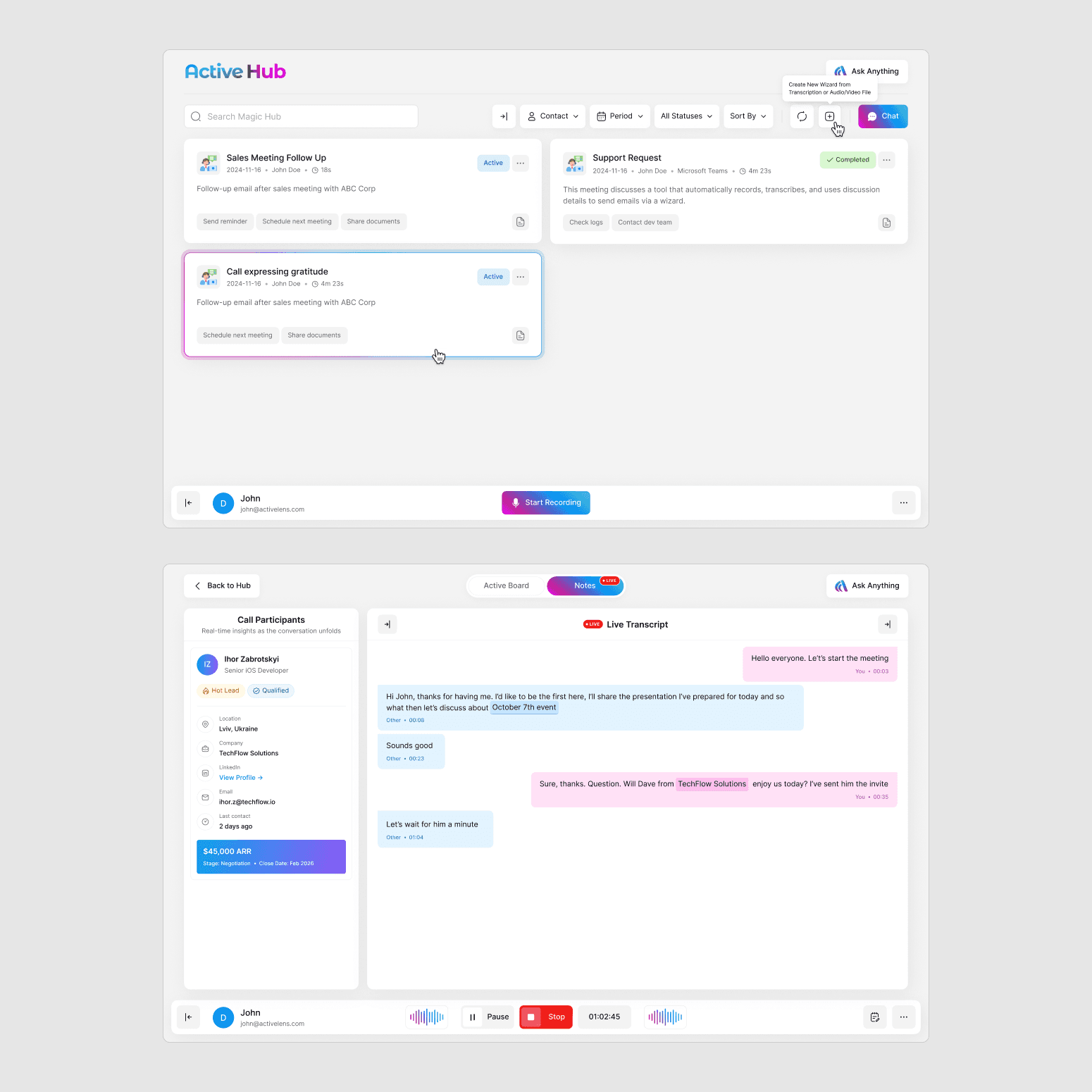
The redesign transformed Active Lens into a cleaner, more intelligent, and scalable product experience. The new interface combines simplified navigation with real-time AI capabilities, allowing users to access relevant information exactly when they need it.
The redesigned product introduces a modern visual language with expressive gradients, motion-inspired interactions, and reusable UI components, while keeping usability at the center of every decision. The result is a platform that feels significantly more intuitive today and flexible enough to support future product evolution.
Overview
Active Lens is an AI-powered meeting assistant that records conversations, generates transcripts, summarizes meetings, and helps teams automate follow-up tasks. While the product already provided valuable AI capabilities, the desktop application had grown without a clear design direction, resulting in a confusing user experience.
As the Product Designer, I led the end-to-end redesign of the product, working closely with the Product Owner, Developer, and Brand & Motion Designers. My responsibility was to rethink the product architecture, improve usability, and prepare the platform for the next generation of real-time AI features.


Goal
The redesign focused on several key objectives:
Simplify navigation and reduce user confusion
Create predictable and consistent user flows
Build a scalable foundation for future AI capabilities
Introduce real-time AI assistance directly into meetings
Improve usability while maintaining a modern, premium visual language
Problem
The existing product suffered from inconsistent navigation, fragmented interaction patterns, and an outdated interface. Different parts of the application behaved differently, making it difficult for users to understand where they were and how to complete common tasks.
As AI capabilities expanded, the product also lacked a scalable foundation to introduce real-time assistance without increasing complexity. Instead of helping users stay focused, the interface often created unnecessary cognitive load.

Process
Research & Product Audit
We analyzed the existing application to identify UX anti-patterns, navigation issues, and inconsistent interaction behaviors. Together with the Product Owner, we reviewed the product vision and defined how Active Lens should evolve from a passive meeting recorder into an active AI assistant.
UX Redesign
The product structure was rebuilt from the ground up. Navigation became clearer, screen relationships more logical, and interaction patterns were standardized across the entire application.
Key improvements included:
Reorganized navigation hierarchy
Consistent screen behavior
Reduced steps for common workflows
Improved readability and orientation
Elimination of unnecessary interaction friction
Product Evolution
Beyond improving existing workflows, we designed entirely new AI experiences, including real-time participant recognition, contextual meeting intelligence, AI-powered action suggestions, and a conversational assistant capable of helping users directly during meetings.
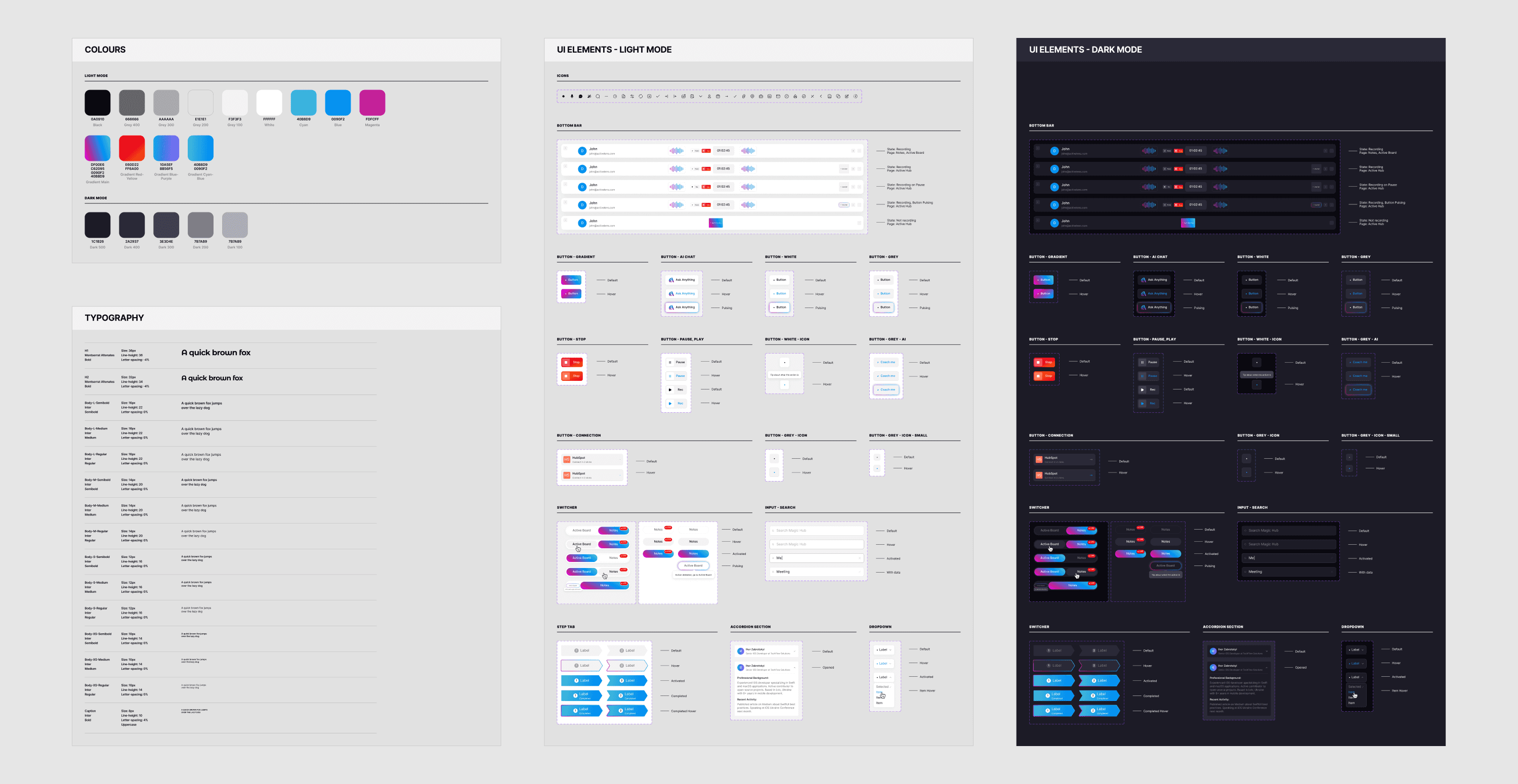
To support future growth, I also created a scalable design system with reusable components, consistent interactions, and visual guidelines that could easily accommodate new AI features.

Reflection
Active Lens evolved from a traditional meeting assistant into a product designed around proactive AI collaboration. By simplifying the user experience, introducing scalable design principles, and integrating real-time AI interactions, the redesign established a strong foundation for the product's future.
For me, this project was an opportunity to combine product thinking, complex UX design, AI interaction design, and design systems into a single cohesive experience that balances innovation with usability.
Shifted AI from passive summaries to the real-time assistant